2026年2月11日 津云:
The Belt and Road Initiative—Our Shared Path | Smart Technology Empowers Cooperation, "Air Silk Road" Connects Times Zones
Every day at 12:00 pm, Zhao Peiqiang, a student from Civil Aviation University of China in Tianjin, gets a punctual video call notification. It's his unspoken appointment with Yakub Kurbanov, Head of the Research and Competence Center of Civil Aviation Academy of Kazakhstan, thousands of miles away.
"These digital twin modeling parameters fit our operations perfectly. They've given us fresh ideas for our local aviation digital transformation!" On the other end of the screen, Yakub shares the latest upgrades to their joint project, clearly excited. Zhao adjusts the backend data soon afterwards. "The airport terrain data and operation and maintenance experience you provided also helped us improve how the system handles cross-border scenarios." These punctual video calls across time zones enable exchange of ideas from the two sides. Young aviation professionals from China and Kazakhstan have planted seeds of friendship through long-term pragmatic collaboration and win-win mutual learning and exchanges.
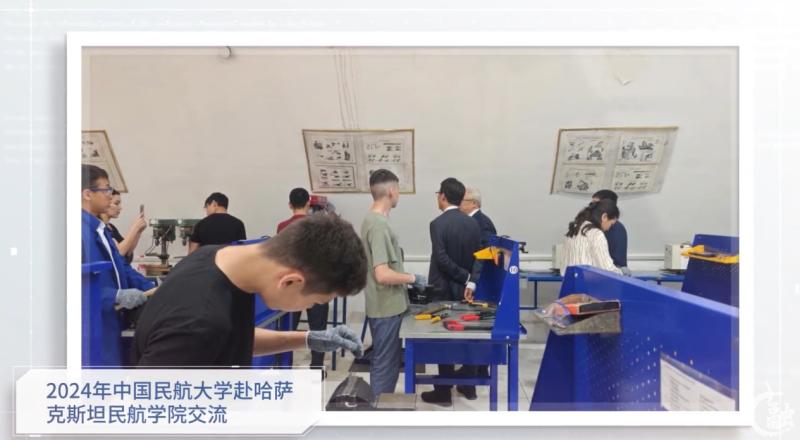
Mutual Learning and Exchange between Civil Aviation University of China and Civil Aviation Academy of Kazakhstan
This teamwork started with a university partnership agreement in 2023. That year, Civil Aviation University of China and Civil Aviation Academy of Kazakhstan officially signed a cooperation agreement focused on joint personnel education and technology sharing, kicking off cross-border aviation collaboration between the two countries. At that time, Kazakhstan urgently needed a digital upgrade to its civil aviation systems, especially for airport maintenance in extreme weather and complex terrain, which required cutting-edge technical support. Meanwhile, Chinese research on smart detection and digital twin technology also needed real-world testing to refine and optimize. The partnership was a perfect match. This inter-university collaboration created the first official channel for exchanges in aviation industry between the two countries, providing a solid foundation for academic and personnel exchanges.
The deepening of the cooperation cannot be done without a platform. In 2024, based on the previous cooperation between the two universities, the "China-Kazakhstan Joint Research Center for Digital Twin Airport" was approved as one of the BRI Joint Laboratories of Tianjin, becoming a core platform for cross-border technology transfer and joint personnel training. With this platform, both sides can quickly implement their research findings. By August 2024, they agreed to first test and roll out their jointly developed digital twin technology at Almaty International Airport in Kazakhstan, turning lab findings from "theories on the paper" to "actual operations on the ground."
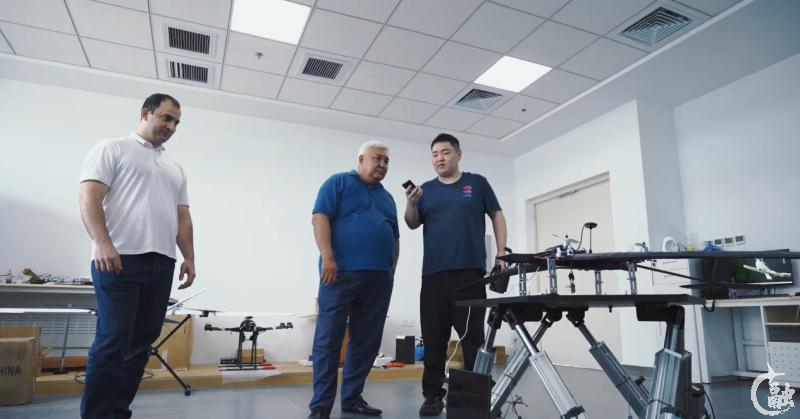
Yakub (left) Visiting a Lab in Civil Aviation University of China
But to apply the smart technologies wasn't a smooth sailing. Kazakhstan's winters are brutally cold, with temperatures dropping to -30 degrees Celsius. The extreme coldness poses huge challenges for the intelligent and automated operations of robots. In May 2025, Yakub came to Tianjin for discussions focused on difficulties on this issue. Walking into the lab of Civil Aviation University of China, the self-developed automated inspection drones and wall-climbing robots immediately caught Yakub's attention. "Can its battery cover the entire body of the aircraft? Can the battery and sensors work reliably at -30 degrees Celsius?" Yakub fired off questions one after another. Zhao answered each one carefully and demonstrated the equipment's detection accuracy and extreme environment adaptability. When he saw the robot collecting detailed aircraft data in high precision, Yakub couldn't hide his excitement: "I finally found the solution for the problems that have been bothering us for years!"
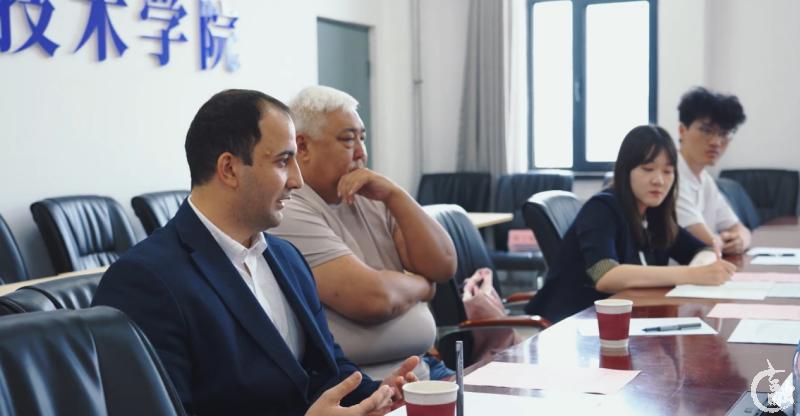
Yakub (left) in a Discussion in Tianjin
This online face-to-face meeting helped both sides pinpoint exactly where to focus their collaboration. Yakub openly shared on-site experience from cross-border aviation operations and airport maintenance in extreme weather. Zhao then tailored technical solutions to make smart equipment better fit Almaty Airport's actual conditions. After that, video calls across time zones and late-night emails became routine. The two always refine technical parameters and adjust application scenarios for multiple times before application, aligning academic innovation with industry needs precisely and deepening mutual trust through countless times of idea exchanges.
After more than six months of joint work, the digital twin system developed by the two sides officially started testing at Almaty Airport. Through real-time linkage between physical scenes and virtual models, the flight scheduling efficiency and facility maintenance accuracy were improved noticeably, effectively reducing extreme weather's impact on the airport's operations.
This two-way flow of technology and experience gave strong momentum to China-Kazakhstan aviation collaboration, generating innovative achievements constantly. Today, flights between Tianjin and Almaty are becoming more frequent, not only opening channels of exchange for trade and people but also spreading the benefits of aviation cooperation to people's daily lives on both sides.
Supported by innovation, empowered by technological cooperation, and linked by personnel exchanges, the deep integration of cutting-edge technologies in aviation and green technologies isn't just outlining the blueprint of future smart airports, but also mapping out a smart new journey of cooperation in science and technology between the two countries. The China-Kazakhstan aviation cooperation is like a flight flying high in the sky, which, powered by the spirit of the BRI, will keep flying on and on, becoming a new driving force for the peace and development of the Eurasian continent.(Jinyun news reporters/ Zhang Jing, Sun Chang; Design and production/Wang Shuyao, Fei Teng)

This global story-collection initiative, named "The Belt and Road Initiative –– Our Shared Path", is guided by Tianjin Municipal Government Information Office, and organized by Jinyun New Media Group. Submissions are still warmly welcomed.Click here to participate.
原文链接:https://www.app2020.tjyun.com/cms_sys/cms_template/000/000/093/index.shtml?_oid=oX6ro0eGn_gs1moHJFrNEjEn76LE&level=2&scene=message&userId=null&jsonUrl=https://static20.app2020.tjyun.com/jyapp/cms_mob/v200/cms_news/000/000/059/147/000000059147293_9b5c06ee.json&isRedirect=true&jy_uid=302505170&from_oid=oX6ro0UZll-seOUDw_vVXJDi2ADU&newsId=059147293&appId=1b8b3255-58d4-4ba7-b0f7-9d136547eb38&resourcesUrl=https://static20.app2020.tjyun.com/jyappv300/cms_mob/v200/cms_oth/chan.json&showFunHead=1&state=STATE